The problematic pronoun

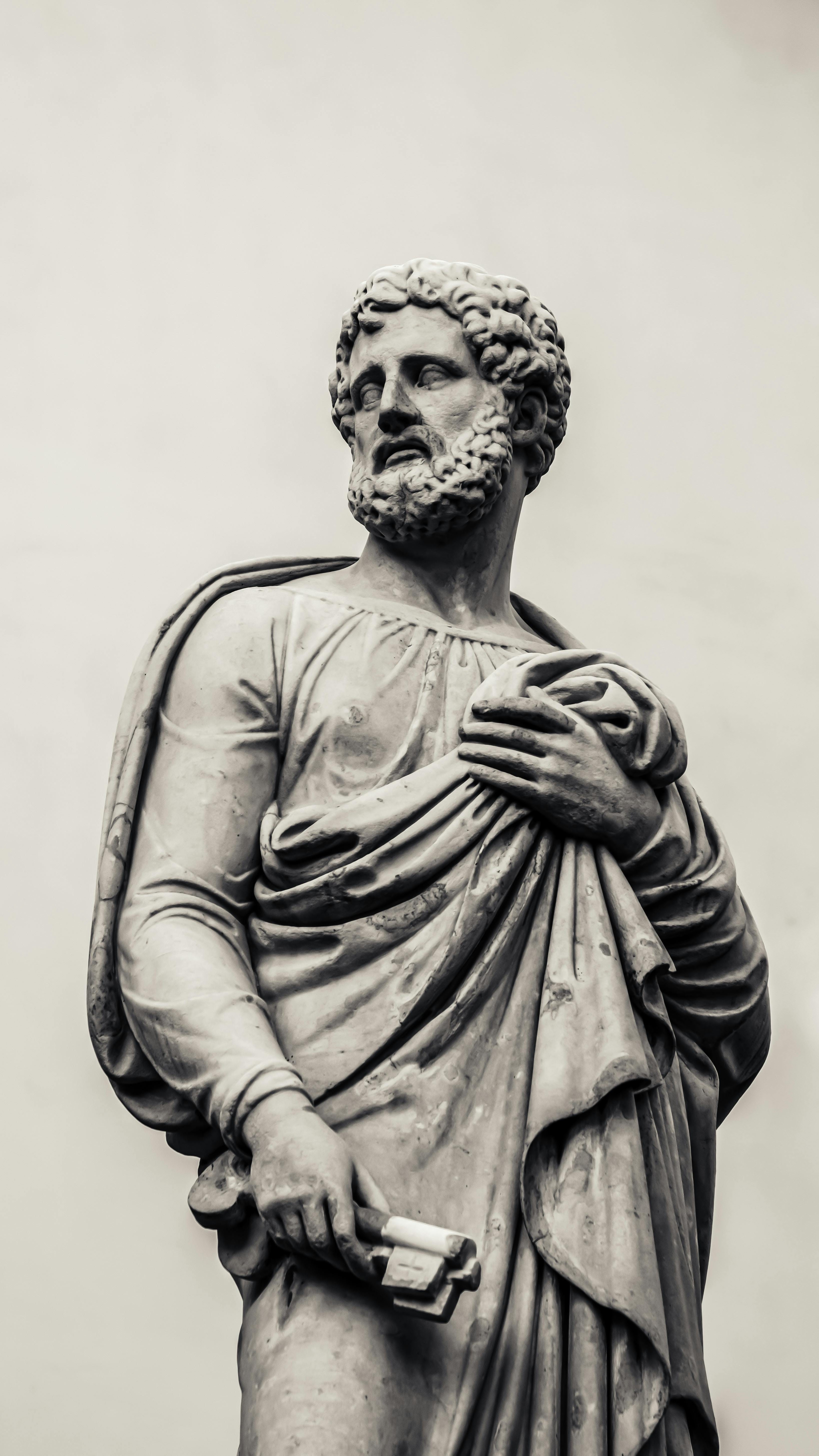
The world’s greatest living philosopher, I Maknosenz, Professor of Philosophy at the University of Roubisch is today’s guest author. Best known for his work on pronouns and their relationship with identity, she invented the word ‘therm’, to encapsulate all genders and none. This controversial idea has riven the philosophical community, with some saying the present gender pronoun usage is adequate while others believe that Maknosenz has not gone far enough. I’m now going to pass you over to our guest author.
As you probably already know, I have coined the term pronominal caesura to describe the distance between pronouns. It is within this distance that we find meaning, as we consider the phonology of the words as well as their temporal and spatial status. Genuflex says ‘a word that does not exist cannot exist until it has been created in our minds’. I would stand that on its head and say a mind that does not exist cannot exist until it has been created by our words. Today, I propose to discuss this in relation to personal pronouns, a passion of mine for many years.
The pronoun ‘he’ differs from the pronoun ‘she’ by one letter, whereas the pronoun ‘we’ only has the ‘e’ in common with both ‘he’ and ‘she’. The pronoun ‘them’ hides within it ‘he’, which suggests that the masculine is embedded in others but not in ourselves. The pronouns ‘I’ and ‘you’ are more problematic, because not only do they have nothing in common with ‘he’, ‘she’ and ‘them’, they also have nothing in common with each other.
To take that a step further, ‘I’ and ‘You’ are non-binary opposites, whereas (as with ‘them’), the feminine ‘she ‘ has the masculine ‘he’ embedded within it. This creates a dilemma. Should we allow the masculine to be embedded in the feminine and indeed exist at the heart of the group constituted by ‘them’, or should we eradicate it entirely? We could refer to the masculine as ‘h’, the feminine as ‘s’ and the group as ‘th’ to decolonise the feminine as well as the group, which may be singularly masculine or feminine or both masculine and feminine.
However, this is not very satisfactory. ‘H’ as a pronoun is interchangeable with ‘h’ as an abbreviation for height, and ‘s’ as a pronoun is interchangeable with ‘s’ as an abbreviation for seconds. Although context may reveal whether an ‘h’ designates a masculine pronoun or is a description of tallness, it is not inevitably so, and it is not inconceivable that at some point in the future, language will conflate the two so that ‘h’ means both masculine and tallness, and ‘s’ means feminine and a measure of time. This risks tallness being considered an attribute of the masculine and a short measure of time becoming an attribute of the feminine. The conflation of feminine with a short measure of time could be construed a gender based insult, as ‘s’ becomes a symbol of the fleeting and ephemeral nature of the feminine. ‘Th’ may be safe to use as long as there is no confusion with the definite article, as may ‘I’ which does not need to abbreviated, but yet again we are in deep water with ‘you’ and ‘we’.
Taking them one by one, ‘you’ would become ‘y’, easily confused with the interrogative ‘why’, which could lead to the singular or plural other becoming associated with a state of unknowingness or perpetual uncertainty. ‘We’, having only the ‘e’ of ‘he and ‘she’ could reasonably be considered exempt from the discussion, but if we did adopt this new convention, ‘we’ would become ‘w’ which is pronounced ‘double you’, embodying a multiplication of others when it is intended to describe a group that includes ‘I’.
One solution is not to pronounce the designated letter as we are taught it when learning our alphabet. ‘H’ would not be ‘aitch’ but a breath at the back of the throat and ‘s’ not ‘ess’ but a sibilant hiss, and so on. But we are still left with conundrum of ‘I’, already a single letter indicating the unique self. We cannot abbreviate it, thereby making it an exception. However, it may not be appropriate to abbreviate it, as ‘I’ embodies nothing but the unique self. ‘You’ can embody one entity or many, and we have already discussed the difficulties of ‘he’, ‘she’ and ‘them. ‘We’ encompasses ‘I’, our unique self, but includes others who are ‘Not I’, thereby creating a distance between the two, and possibly negating the meaning of ‘we.’
Now we come to ‘therm’, my feeble attempt at a solution, which encompasses the masculine, the feminine and a group of others who stand apart, but not the singular or plural ‘you’, which at least is in apposition the unique self or the group containing the unique self. Because ‘therm’ excludes the unique self and both appositional ‘you’s’, it too is unsatisfactory. We could incorporate all personal pronouns into one all-purpose pronoun, such as ‘Withermy’, or ‘Iyshwyt’, my personal favourite as it offers the progression from unique self to one other in direct apposition to the unique self, then feminine and masculine (as you see, in this new word the feminine precedes the masculine, challenging the traditional order), progressing to the unique self as a component of a group of others, then multiple others in apposition to the unique self, followed finally by the group of others who stand apart from all.
We are by no means close to the ideal pronoun or set of pronouns, and we have not touched on the pronoun in other languages and cultures, but with this new field of pronounology, we are already pushing the boundaries of language.

Thank you. I'll take that a a complimenf!
The cats are still there listening; they never left!